Tuesday, 24 April 2012

Frank Odoi – great artist and friend - passed away


This is how we remember Frank, here surrounded by kids at his exhibition in Helsinki Comics festival.
Sad news from Nairobi reached us today. Cartoonist Frank Odoi, friend and colleague, and one of the sharpest brushes in Africa, died on Saturday, April 21, in a bus accident. He was 64 years old. He is survived by his wife Carol and two daughters. Our thoughts and sympathies go to them as well as to his colleagues and workmates, Gado, Maddo and Kham.

 
We go back with Frank more than 20 years. He worked with us in several comics workshops (Tanzania, Mozambique, South Africa, Ethiopia, and Finland). We also had many joint book and exhibition projects over the years.

 
Frank visited Finland five times, and we are especially grateful that he could make it to the Helsinki Comics Festival in 2011.

Rest in Peace, Frank!
World Comics Finland team

Friday, 20 April 2012

Joensuulaisnuoret piirsivät sarjakuvia vaikuttamisesta

(Summary in English below)

Anu Seppä, luokka 8A
Joensuulaisilla yläkouluilla oli mahdollisuus tilata tänä keväänä oppitunneilleen Nuorten akatemian kouluvierailijoita. Maailman kuvat-työpajassa käsitellään globaaleja kehityskysymyksiä ja vaikuttamista. Tarkoituksena on saada oppilaat pohtimaan, kuinka maailmanlaajuiset ilmiöt, kuten ilmastonmuutos ja köyhyys vaikuttavat ihmisten elämään meillä ja muualla. Samalla mietitään, miten suomalaisnuoret voivat itse vaikuttaa näihin asioihin. Aiheen ymmärtämistä vahvistaa siitä toteutettava sarjakuva, joka viestii nuorten ajatuksia myös muille samanikäisille.

Työpajan alustukseen kuului karttatehtävä, jossa nuoret selvittivät, missä ilmastonmuutos ja köyhyys vaikuttavat eniten ihmisten elämään sekä missä maissa heidän vaatteensa oli valmistettu. Yhden ryhmän tytöt yllättyivät, kun lähes kaikki heidän vaatteensa oli tehty Bangladeshissa. Kävi ilmi, että ne olivat saman merkin valmistuttamia. Useissa sarjakuvissa puitiinkin tekstiiliteollisuuden epäkohtia Kaukoidässä. Muita suosittuja aiheita olivat mm. napajäätiköiden sulaminen, varainkeruu hyväntekeväisyyteen, nälkä ja saasteet. Sarjakuvan tekemisen kautta nuoret havahtuivat näkemään, kuinka maailmanlaajuiset ongelmat koskettavat heidän elämäänsä.

Monet nuoret kokivat, ettei työpajan teemoja ollut käsitelty tarpeeksi muilla oppitunneilla ja he olivat työpajasta innostuneita. Osaa aiheet eivät juuri kiinnostaneet, mutta sarjakuvan tekemisen avulla heillekin jäi varmasti jotain työpajasta mieleen. Usein nuorilla oli vaikeuksia pysyä aiheessa, ja sarjakuvia alettiin piirtää vaikkapa mopoista ja lemmikkieläimistä. Jotkut nuoret halusivat käsitellä sarjakuvan avulla myös rasismia ja omia ennakkoluulojaan. Välillä ohjaajat puuttuivat epäasiallisiin sarjakuviin.


Joensuussa järjestetyt kouluvierailut olivat 180-minuuttisia. Aika ei tuntunut riittävän millään ja monia nuoria harmitti, etteivät he saaneet sarjakuviaan valmiiksi pajan aikana. Opettajat tarjosivat kuitenkin mahdollisuuden jatkaa työskentelyä myöhemmin. Motivoijana toimi Joensuun kaupungin kirjastoon maaliskuussa tuleva näyttely, johon valittiin muutama sarjakuva kustakin työpajasta.

Maailman kuvat-työpaja on kouluille ilmainen ja kouluvierailijoita voi tilata Nuorten akatemiasta, http://www.nuortenakatemia.fi. Paja on suunniteltu yhteistyössä Eettisen kaupan puolesta ry:n, Changemaker:n, Maan ystävät ry:n ja Maailman sarjakuvat ry:n kanssa ja sen on rahoittanut Ulkoasiainministeriö.

Näyttely oli esillä Joensuun kaupunginkirjaston eteisaulassa 12.-24.3.2012

Sanna Hukkanen
Pielisjoen koulun 8 A-luokka käy läpi sarjakuviaan kouluvierailija Sana Hukkasen ohjaamana. Kuva  Niina Piispa.

Mikael Lindberg, luokka 8 A

Summary in English: This year, school children in Joensuu participated in workshops in which they made comics about global issues and how to influence them. These workshops are run by school visitors engaged by the Maailman kuvat (Images of the World) -project, organized by Nuorten Akatemia (Academy of the Youth).  The three main themes in the project are poverty, climate change, and global textile industry.  

The project is funded by the Ministry for Foreign Affairs from Development Educations Funds. World Comics Finland is one of the partners in the project, mainly by developing the comics workshop procedures and by training school visitors.

This posting was written by Sanna Hukkanen, who is one of the school visitors in the Joensuu area, and a member of World Comics Finland.


Thursday, 19 April 2012

Campaign comics book


Still relevant!

The Ministry for Foreign Affairs of Finland published in 1999 the guide book "Comics with an attitude…" on how to use comics in development information work. It was written by Leif Packalen and Frank Odoi and it was directed to NGOs as a guide on how to produce comics in different campaigns. The book was very popular, and it was distributed free of charge by the Ministry (eight printings, 14000 copies).

We still get requests for the book, which is a hands-on guide and has a lot of interesting campaign comics samples from different parts of the world. The basic information in it is still valid and it is quoted frequently in various articles discussing the role of comics in development and human rights work. A recent example is Ellen and David Yamshon's  Comics Media in Conflict Resolution Programs:  ARE THEY EFFECTIVE IN PROMOTING AND SUSTAINING PEACE? (published in the Harward Negotiation Law Review. )
  
The book is out of print, but we still have a few hard copies if there is an organization that would need it. It is also available in electronic form in four chapters at the Ministry's website.  The links are below:


Friday, 9 March 2012

Photographs from KAPLET, Kenya.

We received some nice photographs from Kamukunji Paralegal Trust (KAPLET), Nairobi. KAPLET is one of the organisations, whose activists were trained at our grassroots comics workshop (with Youth Alive! Kenya) in October 2011.
KAPLET's programs include civic education, legal first aid, cases documentation and referrals, drafting of legal documents, health and human rights advocacy, and other community paralegal services.

The photos were shot by Erick Otieno Owuor, David Oginga Makori and Dan Owalla at a recent workshop conducted by Millicent Awino and Michael Oduor.

Friday, 24 February 2012

Comics by immigrants in North Karelia, Finland

Grassroots Comics were made by immigrants, refugees and Finns in two workshops in the Joensuu area. The workshops took place in October and November 2011 at the multicultural centre Vatakka in Joensuu and at the Kontioniemi reception centre for asylum seekers. Both are run by the Finnish Red Cross. The tutors and organisers of the workshops were artists Sanna Hukkanen and Sunday Mpanduji and the project was funded by Otto A. Malm’s Donation Fund.

The many faces of Antoni Kokko. Picture: Sunday Mpanduji.
The participants of  the Vatakka workshop were mainly Finnish, though a few immigrants participated, too. It was difficult to get immigrants involved.  The participants chose to make their comics about prejudice. They showed strong enthusiasm for comic making, and some of them managed to complete two wallposter comics. The organizers also hoped to get the voices of immigrants heard, so another comics workshop was held in Kontioniemi.

The residents of Kontioniemi centre are quite isolated as it is located far from town. They chose the theme Finland for their comics, but when they started creating their stories, many complained that they had very little experience from Finland. One participant was drawing a tree and stars, and when asked, he explained that it was all he had seen in Finland, “the tree and stars just outside the door”. Some participants made comics about Finnish climate that was new and extreme to them. One commented on the isolated conditions at the reception centre and also told about his background in his comic. 

In Kontioniemi there were some language difficulties in teaching, since everybody seemed to speak a different language. Some participants didn’t have any earlier experience of comics, so the whole concept was new to them. Despite the difficulties many wonderful comics were created during the workshop. The participants were happy and proud to get a chance to express themselves through the medium of comics.

The comics made during both workshops were displayed in an exhibition in Vatakka and distributed in the Joensuu area as posters and booklets. Two of the comics were even published in the local newspaper Karjalainen.

Sanna Hukkanen

I fled Iraq, when my life was in danger and came to Finland. I was safe.  Soon I felt like a prisoner, I had not seen my children and wife  for a long time.  I miss them so much.  Story and art by Yashar Abdokarim-Shakr.

Musa was in Helsinki last year and tried skating. He fell on the ice and the onlookers laughed.  He was ashamed.  This year he wants to try skating again. Story and art by Musa Mohammadi.


Friday, 17 February 2012

Kenya comics workshop (ToT) 2011


Comics Power to Kenya, enjoy and get inspired!

Saturday, 4 February 2012

More comics from Burundi


We recently received more grassroots comics from APDH (Association pour la Paix et les Droits de L’Homme), our partner organisation in Ngozi, Burundi. The comics have been made in their network of human right clubs.

They take up issues such as land problems, violence against women, right to education, communal harmony, etc.

Below three samples in Kirundi with English and French translations provided by René Claude Niyonkuru, Coordinator of the Comics Project.

“Indyane z'amatongo” A man hires a killer to eliminate a landowner in order to appropriate his land. His brother intervenes and reports it to the the court. The criminals are sentenced to life in prison.

Story and artwork by Chris-Nathan Akimana of DH (LCUM)

Un homme engage un tueur pour éliminer un propriétaire d’un fond de terre afin de s’en approprier. Son frère saisit la justice pour dénoncer l’affaire et les
criminels se voient condamner à perpétuité.

“Indyane z'imigabwe” A man had strong negative feelings for his political opponents. He thought they wanted him harm only. But paradoxically, it was one of them who came to his aid when he fell into a ditch when chased by a rabid dog.

Story and artwork by Kaze Sosthene  of  L.C.Club de Muremba

Un homme voyait d’un mauvais oeil ses opposant politiques. Il pensait qu’ils ne lui voulaient que du mal. Mais paradoxalement, c’est l’un de ceux-là qui lui vint en aide quant il tomba dans un fossé pourchassé par un chien enragé.
“Ntiduturubike ibibondo” A child raised by a stepmother is unable to attend school like other children. He is reduced to slavery and has to do all the work of the house. He is rescued by a defender of human rights, who pleads for him successfully.

Story and artwork by Niyonizigiye Eddy, club APDH (LCUM)

Un enfant élevé par sa marâtre est empêché de fréquenter l’école comme les autres enfants. Il est réduit à l’état d’esclavage et fait tout les travaux de la maison. Il est secouru par un défenseur des droits de l’homme qui plaide pour lui avec succès devant ses parents.


Burundi – comics help people to participate


 René Claude Niyonkuru, Lawyer and Land Consultant, Coordinator of APDH’s Comics Project.


APDH (Association pour la Paix et les Droits de l’Homme) is World Comics Finland’s partner organisation in a grassroots comics project in Burundi. The project started in 2010 and has now reached almost completion. 

A quote from a report by APDH’s Comics Project Coordinator René Claude Niyonkuru:

Grassroots comics were introduced in Burundi for the first time with this small project but it didn’t take a long time to discover, both for APDH, its partners and the community, how useful and powerful it is as a development and social change communication tool.

In the beginning, there was hesitation and confusion, where people, not familiar with mass education, were sceptical that no one, among communities or decision makers, will ever take into consideration “banal drawings” from rural women or young pupils in schools; that the well-educated cannot “waste time” drawing to express their views while they can use well-articulated speeches!

Other people were afraid, stating that drawing is not an innate talent, available for everyone!” …

“As it is relevant, especially for our rural and illiterate beneficiaries, the project needs to be pursued.

Grassroots comics will surely help as a communication tool in the preparation and the functioning of the Truth and Reconciliation Commission, and, once again in the preparation of the 2015 elections. We need people and communities to participate in the whole process, and we need tools and techniques for that.”…

More samples of comics made by clubs and groups in APDH’s network will soon be posted here.


Critique session at a comics workshop in Ngozi, 2011


Friday, 3 February 2012

Plano de treinamento para facilitadores de workshops de quadrinhos


The Portuguese translation of our trainer’s manual, for the use of grassroots comics trainers, is finally available. The trainer’s manual has 40 pages, and it can be downloaded fromhttp://www.worldcomics.fi/pdf/portuguese-workshop-training-plan.pdf

This manual is a step by step guide to how to run a grassroots comics workshop. It should be used together with the basic grassroots comics manual, which is handed out to workshop participants. The basic manual is available on: http://www.worldcomics.fi/pdf/portuguese-wallposter-manual.pdf

Thursday, 2 February 2012

Koivisto, Hagelberg, and Tukiainen received their Puupäähattu-awards 1978, 1997, and 2003.

Inspired by Kaisa Lekas’s Pupäähattu- award (see blogpost entry 15.1.2012) we had a look at other Puupäähattu-awardees within our membership. So, in chronological order:


TARMO KOIVISTO

Tarmo Koivisto, a founding member and Vice-Chairman of World Comics Finland, received the Puupäähattu-award in 1978. He is one of the pioneers of modern comics in Finland. His Mämmilä series, which he started as a strip in 1974, deals with contemporary Finnish life in a small fictive town. His comics comment on issues such as the first African refugees and membership in the European Union. Mämmilä town has numerous colourful characters. Over the years Mämmilä has proved to be one of the most-loved comics in Finland.

Tarmo has been a trainer in several of our workshops in Tanzania and India.

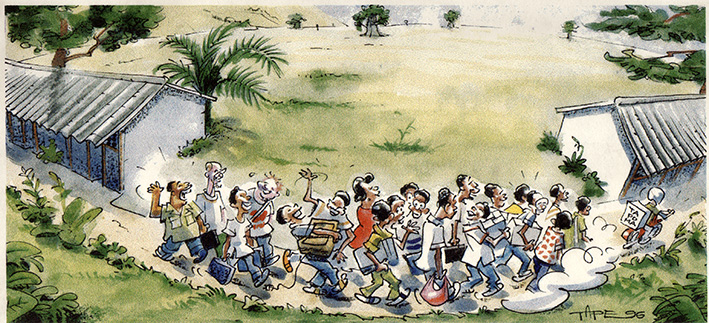
Tarmo’s own drawing  of the comics workshop with TAPOMA in Morogoro, Tanzania, in 1996. We had to shift from one classroom to a bigger one. One can see Katti Ka-Batembo on his motorcycle,  Gayo carrying his light-table and in the last row, Frank Odoi and Leif Packalen. Tarmo has drawn himself, sweating.
  
Tarmo teaching at our first workshop in India, in Tamil Nadu in 1997 with VCDS. This was where we discovered the idea of grassroots comics.


 MATTI HAGELBERG and KATJA TUKIAINEN


Matti Hagelberg and Katja Tukiainen  have both influenced the comics scene in Finland tremendously. Matti got his Puupäähattu-award in 1997 and Katja hers in 2003. Both have also worked as comics trainers in our workshops in India.

Katja has been a World Comics Finland board member since 2000. Her commitment and creativeness have been great assets to our organisation. To get a full picture of Katja pls check her homepage www.katjat.net.

Matti Hagelberg has produced 18 comic albums and is also widely published abroad. He is a long-time member of World Comics Finland.

Katja and Matti in a workshop with WCI, in 2004, in Aizawl, Mizoram, India.


Katja’s drawing from the VCDS’ workshop in 2001 in Tamil Nadu, India.
Matti’s drawing from the VCDS’ workshop in 2001, in Tamil Nadu, India


Thursday, 26 January 2012

New Grassroots Comics from Kenya (first batch)


World Comics Finland’s cooperation with Youth Alive! Kenya is progressing well. The first grassroots comics workshops, run by the tutors who were trained in October 2011, have been held, and we have already received wonderful comics samples from the workshops held by KAPLET and Undugu Society of Kenya.
 
The selection of comics below takes up issues such as sexual abuse of children, traditional medicine, and drunken driving. The summaries have been translated by Rachael Wandia of Youth Alive! Kenya.

The comics show that the new tutors have been able to competently guide and inspire the participants, who are all social activists.

More samples and reports will follow soon!
In the story, we see three mothers cuddling their children who are unwell. One of the women says that she will give her child some traditional medicine she was given by her mother. Later, we see her lamenting because her child is dead. The story ends with the women seeking treatment from the local clinic having realized that the traditional medicines do not work.

Story and artwork by Mercy Njoki of KAPLET (Kamukunji Paralegal Trust).
This comic shows effectively the consequences of drinking and driving.

Story and artwork by Victor of KAPLET (Kamukunji Paralegal Trust).
The story is about a young girl who is sexually abused at home by her father. Her mother takes her to the police station to report the incident and they go for some tests in hospital. The doctor confirms that the girl has been raped. In the last panel the father is arrested by the police due to defilement.  
Story and artwork by Pinchez Shizzle, a member of one of the association groups from Undugu Society of Kenya.


Friday, 20 January 2012

Kaisa Leka gets Puupäähattu prize

We congratulate Comics Artist Kaisa Leka who was yesterday awarded this year’s Puupäähattu prize. It is a prestigious, annual prize awarded by the Finnish Comics Society to an accomplished Finnish comics artist. The prize was named after the hat of of Ola Fogelberg’s classic character Pekka Puupää.

Kaisa Leka is a member of World Comics Finland. She took part in the  Rajasthan workshop in India in 2009 as a trainer (see report:  http://www.worldcomics.fi/pdf/report-october-2009-rajasthan.pdf). She has her own blog as well:   http://kaisaleka.blogspot.com/


Other members of World Comics Finland who have received the Puupäähattu prize are: Tarmo Koivisto (1978), Matti Hagelberg (1997), and Katja Tukianen (2003). We will return to them in another blog posting. 


We are proud to note that so many of our members have received the Puupäähattu Award. They have combined extraordinary talent and wit with commitment and vision.  L.P

Kaisa Leka listens to the award speech by Otto Sinisalo, Chairman of the Finnish Comics Society. The ceremony took place 19.1.2012 in the Helsinki University Library.


Kaisa Leka in Rajasthan with Lobsang Tzering, a participant in the workshop where she was a trainer in 2009.  The workshop was part of World Comics Finland's India Programme.

Tuesday, 17 January 2012

Michael Sagikwa (Tanzania): Campaign comics on human rights issues


Michael Sagikwa (Tanzania) sent us samples from two human rights comics which he made for the Common Ground’s campaigns in Tanzania.

We met Michael first in Morogoro, where he is still based, in the 1996 workshop for comics artists and illustrators. We were immediately struck by his neat artwork and superb hand-lettering. Michael was an apprentice with Katti Ka-Batembo for some time until his own career took off. He has worked for many organisations both with educational campaign comics and illustrations. You can also check him on his blog: http://sagikwa-mike.blogspot.com/  

L.P


Below are some sample pages from the stories, “Kwenye njia ya haki” (On the right path) and “Aisha”.

A sample page from Aisha.


Aisha is about sexual harassment. A secondary school teacher tried to rape Aisha. He pretended to help her to improve in Math and invited her to his house. Luckily Aisha managed to escape.

News reached Chacha, Aisha’s father's friend who together with his wife and
Aisha's mother went to file a complaint at the police station against
the teacher (Mr. Muganda). He was later sentenced to 30 years in prison
according to Tanzanian law for such acts.


The Chacha story is about police corruption in Tanzania, and illegal arrests and violation of human rights at the police stations. Chacha, the main character of the series, is being arrested illegally but released a day after the intervention of the OCD (police officer commanding the district).


The police officer solisicts a bribe.

The cover of the booklet.
A sample page fom Chacha.


Hagelberg and Tietäväinen: new books


Two of our trainers, Matti Hagelberg who taught several times in India, and Ville Tietäväinen who taught twice in Tanzania and once in India, have recently published extraordinary comics albums.
The cover of  Hagelberg's album. 
Matti Hagelberg’s album “Intia sataa paraatilleni” (India rains on my parade) is about his trip to India in 2003 for training at comics workshops . The trip took him from Delhi to Tatanagar and then to Mizoram.  Hagelberg describes the trip in his unique, laconic style, blending truth with fantasy in a visually stunning mix. 

The story was first published in French (L’Association en Inde, 2006) and in Swedish (Optimal, 2008). The Finnish version has been published by Kreegah Bundolo. (http://www.kreegah.net/). Hard cover, 32 pp, ISBN 978-952-67008-6-1

The book is highly recommended. L.P
The cover of Tietäväinen's book.


Näkymättömät kädet  (Invisible hands) by Ville Tietäväinen was a major event in the comics scene in Finland in 2011. It tells the story of a Moroccan family father who migrates to Spain. Immigration is a hotly debated issue all over Europe and Ville’s book shows the grim reality of the immigrant.

The book took five years to complete and we should all be grateful to the Arts Council of Finland who awarded Ville a five-year grant in 2006. The book is an important read, well researched, visually brilliant, with meticulously crafted dialogue.  Hopefully it will be available in other languages soon.  

Book info: Published by WSOY, Helsinki in 2011, hardcover, 216 pp, ISBN: 978-951-0-37928-8

Check out Ville’s work on http://linjamiehet.fi/villetietavainen/

L.P


Tuesday, 10 January 2012

Frank Odoi at the 27th Helsinki Comics Festival


The Kenya-resident, Ghanaian cartoonist and comics artist, Frank Odoi, was our visitor at the Helsinki Comics Festival, 17-19 September, 2011. His trip was co-sponsored by the Finnish Comics Society and World Comics Finland.  He gave a presentation at a Seminar on Comics in Development, and was interviewed on stage and signed his album Golgoti.

An exhibition called ”Frank Odoi – a Versatile Comics Artist” with his comics, cartoons and illustrations, took place at the Tapulinkaupunki library in Northern Helsinki.

Since 1991, when Frank first met with Leif Packalen in Nairobi, he has been an important colleague in World Comics Finland’s activities. He  worked as a trainer at comics workshops  in Tanzania, Mozambique and Ethiopia, and he co-authored the book ”Comics with an Attitude..” which was published by the Ministry for Foreign Affairs of Finland in 1999. The book reached a total of eight printings! It is available as a pdf-file at  http://formin.finland.fi/Public/Print.aspx?contentid=89646&nodeid=34606&culture=en-US&contentlan=2


Frank shares reminiscences from Tanzania, where he and Tarmo Koivisto trained comics artists in the Nineties. Henry’s Pub, the official watering hole for the festival, was of course decorated with comics.

Frank took time to come to visit us in Vantaa. Here with Birgit Packalen in front of the two local sights: the plastic petrol station and the water tower. LP.
Frank visited the library in Tapulinkaupunki, Helsinki, where his exhibition was on display. The exhibition showed the great variety of comics and cartoons that Frank has done, from adventure and fantasy comics, political satire comics, children’s comics to editorial cartoons, caricatures, gag cartoons, illustrations, etc.

The poster for Frank's exhibition.

A group of kids from the neighbourhood had arrived to see Frank at the exhibition. Frank spent an hour drawing and joking with them. He got rock-star treatment from the kids. Drawing: LP.

Comics empowerment in Kenya


World Comics Finland started cooperation with Youth Alive! Kenya (www.youthalivekenya.org) in October 2011 with a training of trainers (ToT) workshop. Below pictures, drawings and comics from the workshop. 

One of the 18 ToT-workshop participants Buthaina Ibrahim of Undugu Society of Kenya, showed her wallposter comics to people in the Limuru market. Especially the kids were mesmerized. Photo Hanna Arvela.


Hanna Arvela and Leif Packalen of World Comics Finland were trainers at the workshop. Drawing: LP.


Group photograph from the trainers' workshop in Limuru.
Immediately after the ToT-workshop, the new trainers practised their skills in a three-day test workshop in Pumwani Social Hall in Kamkunji. Here Festus Mwiti (left) and Michael Oduor (right) instruct social activists from different organisations in the Kamukunji area. 

To get feedback to the comics from ordinary people in the community, is always important. Interaction with people gives insight into how the comics are actually understood, and what could be made in a different way. Drawing: L.P.

Ms. Mildred Aiwso of KAPLET (Kamukunji Paralegal Trust) made the story about violence against women. The husband beats his wife and she reports it to the Police Chief, who calls a meeting of the elders. At the meeting the chief speaks against the violence.

Festus Mwiti of Gay Kenya Trust made this strip about a gay person who was harassed by a couple. The police intervened and arrested the couple. The strip is called “Gay rights are human rights”. Being homosexual was only very recently decriminalised in Kenya, so this information needs to be spread.