Thursday, 7 January 2016

Maddo's take on Nairobi transport wins him a CNN Award

Maddo with his award

MADDO (Paul Kelemba)  Kenyan cartoonist and creator of the long running and extremely popular It's a Madd Madd World cartoon in the Standard (see blog posting August 2013) was in 2015 awarded a CNN Award for his cartoon called ”Sorting out Nairobi Transport”. It was chosen from entries spanning 39 nations across the African continent.

CNN gives annual awards for outstanding journalism in Africa.  Paul Kelemba's piece was the first CNN award to have ever been given to a cartoon. It gives recognition to the fact that also cartoons can be seen as solid journalism.

To complete ”Sorting out Nairobi Transport” has involved a lot of research, sci-fi modelling, etc. And, as usual, Paul Kelemba pokes gentle fun at his fellow Nairobians which makes the cartoon even more enjoyable.

Congratulations to Maddo, who is, incidentally, at the time of my writing this, struggling in severe  sub-zero weather in Estonia on a visit to the University of Tallinn.

Leif Packalen


The Madd Madd World Special "Sorting out Nairobi Transport"

Monday, 4 January 2016

Iraqi refugees at "Hei Helsinki" comics workshop

Two panels from Firas Sabar's comic about his perilous journey from Iraq. The story ends with his arrival at Helsinki airport. Note: In Arabic you read from right to left.

Hei Helsinki arranged a comics workshop for a group of Iraqi asylum seekers. They stayed in Helsinki at at a reception centre, but the workshop was held at Kiseleff’s house in Hei Helsinki’s premises in three sessions in November - December. The workshop was facilitated by Leif Packalen of World Comics Finland. The Iraqi artist Mohaned Durubi did the interpreting at the workshop.

During 2015 an unprecedented number - about 30.000 - of migrants came to Finland to request for asylum. This put a lot of strain on the authorities, but also generated many positive initiatives from NGOs and spontaneous groups. The Hei Helsinki initiative is a good example.


Samples from the workshop:

Hasheim Jama's story about the car bomb that killed his father.


A detail from Khattab Uday's comic about the religious fighting in Bagdad. The man with the gun says: Either you follow us, or we will kill you.
A detail from Mohammad Al Fith's love story, which ends with a broken heart. 

Alaa Al Abady's story is about his journey to Finland and the reunification of his family here.

Posted by Leif Packalen


Thursday, 5 November 2015

Immigrants' voices in Joensuu, Finland


The participants in the women's workshop were proud of their comics

The multicultural association ”JoMoni” organised three Grassroots Comics workshops for immigrants in May-September 2015 in Joensuu, Eastern Finland.  The project was coordinated by artist and comics tutor Sanna Hukkanen. The idea was to introduce a new channel of expression through art, to enable the participants to share their experiences with Finnish readers in order to promote cross-cultural understanding.

The first two workshops were for immigrant women, and a few Finns participated too. The third workshop took place in the North Karelia municipal education and training consortium in Niittylahti. The participants were a group of young people attending a preparatory course for immigrants (VALMA) and the theme of their comics was ”A personally important issue”. The project gained more significance since it was organised amidst the present refugee crisis and the hardened attitudes in Finland.

The majority of  the participants had no experience in drawing comics. They were, however, quick learners and in the end, proud of their own art work. The VALMA group's teacher felt that it was really important for the students to process their personal experiences in comics. At the same time they had an opportunity to experiment with a new medium, and the results, the final comics, enhanced their self esteem. Also the female participants gave positive feedback. They found comics a good tool for reflecting cultural and personal issues. They were happy to get to know each other and to have a chance to talk about the issues that were important to them. 

As the participants came from very different backgrounds their comics dealt with a broad range of subjects. Common subjects were: cross-cultural friendship and the importance of finding friends in the new environment, introduction of one's own culture to the Finns, Finnish language, girls'/women's rights and descriptions of every day life in Finland. The comics were displayed in an exhibition which was opened at the Joensuu Comics Event in October 2015 at Joensuu main library, and then sent to other libraries around North Karelia. Also a booklet was produced which will be used in JoMoni's anti-racism campaigning. 

The comics can be read at JoMoni website: https://jomoni.wordpress.com/media/jomonilaisten-sarjakuvat/ 

Posted by Sanna Hukkanen
A panel from a comic dealing with Finnish language


Comic by Kyoko

Did you know? / There will be no earthquake in Finland / Tsunami won't strike / There is no war / Finland is a happy country.

Friday, 28 August 2015

Riad Sattouf - L’Arabe du futur

A page from Sattouf's album. The family arrives in the father's home village in Syria.

Riad Sattouf’s (born 1978) autobiographical comic L’Arabe du Futur (The Arab of Future) was a great hit in France and has sold several hundred thousand copies by now. The second album is already out in France and an English version of the first book will be available in October 2015 (Barnes and Nobles, UK). A Finnish version (WSOY) is already in the shops.

Sattouf tells the story of his childhood in France, Libya, and Syria in the Eighties. His mother is French, his father a French-educated Syrian professor who takes up teaching jobs in Libya and Syria. From France the family moves first to Libya, then to the father's home town, Homs, in Syria. The father has great hopes for the future of the then prevailing Pan-Arabic movement and works under two dictators (Gaddafi and Hafez-al-Assad). Sattouf is very young and sticks out in both countries, as he has blond hair. 

Sattouf tells his story with both robust and gentle humour and manages to portray the life of a young boy in a strange environment in a believable way. 

Autobiographical comics like these do much more for understanding between  cultures than any regular campaign material against xenophobia and anti-racism.

Read more about the album: http://www.allary-editions.fr/publication/larabe-du-futur/ (in French)

Posted by Leif Packalen


The album cover


Travel comics from South Caucasus


A page from Aino Sutinen's book of travel comics
Aino Sutinen (born 1983) has published a book on her travels in Azerbaijan, Georgia, Armenia and Nagorno-Karabakh in the South Caucasus. It is in Finnish, with English subtitles on every page. 

Vaimoksi vuorille – Reppumatkasarjakuvia Etelä-Kaukasiasta 
Mountain Wife – Backpacking Comics from the South Caucasus
120 pages (Neon Tunisia, 2015)

This is a charming book. Aino Sutinen seeks out the less-trodden paths without making it into an extreme sport. She seems to easily establish rapport with people and writes about them with open curiosity and kindness. This is a refreshing attitude after several travel comics (mostly by men) where the traveller often portrays himself in terms of heroic endurance among locals.

Aino Sutinen has travelled, as it were, on our behalf and joyfully shares her experience with all of us. Read the album and enjoy!

More information:  http://aino.sarjakuvablogit.com/uusi-kirja-new-book-matkasarjakuvia-travel-comics/

Visit Aino Sutinen's blog with photographs from her trip: http://aino.sarjakuvablogit.com/


Posted by Leif Packalen

Wednesday, 5 August 2015

Nenets and Hanti comics from Northern Siberia


The school girls from Salekhard read their own comics in the Hanti and Nenets languages.
Elsa Sysser, a mother-tongue activist from Finland wrote to us some time back how she uses comics in promoting vulnerable languages. She has recently worked with a small team in Jamal, Northern Siberia. They went to schools and one class at a time, and instructed the pupils in how to make comics. Although they had only limited time at their disposal, the comics came out well. Especially the comics made by 5th graders in Jar-Salen were engaging. They were about summer on the tundra and one can see that the children know how to draw their environment - and reindeers.

In addition to giving expression to their culture by drawing, these comics use the vulnerable languages of Nenets and Hanti - the children’s mother tongues.

The comics classes will continue, and the schools have been very welcoming. Next they will try the same methods with adults.

Elsa Sysser concludes her message with a thanks to World Comics Finland for good instruction materials and inspiration. We look forward to seeing more comics from Siberia in due course.

Posted by Leif Packalen


A comic about reindeer animal husbandry
While collecting firewood the girl finds a pet rabbit

Summer activities in Jamal, Siberia 

Tuesday, 4 August 2015

Two outstanding graphic memoirs on ageing and death

The subject of ageing and end-of-life care is difficult and always very personal. Two American cartoonists, Joyce Farmer and Roz Chast, have each written and drawn graphic memoirs of the last phases of their parents' lives. These two books, although in an American setting, are extremely important reads. 

The doctor telephoned to say the father has lung cancer. A scene from the album.

Joyce Farmer (b. 1938) is a pioneering feminist underground cartoonist and her 200-page book "Special Exits" is her first full-length graphic narrative. The story is about her father and stepmother, whose lives and circumstances deteriorate in a poor South L.A. neighbourhood. 

Farmer has to take charge of their lives and balances between what is practical and what the parents want. The parents' opinions are often also conflicting and Farmer has to thread carefully in the crossfire of strong wills. Both parents have their own collections of things from the past that fill the house. The stepmother manufactured dolls in her past and collected pieces of cloth etc. The father has his collections of rocks.

The parents have a cat, which in the end is taken to Farmer's house. The cat has never liked her but in the very last scene the cat cuddles up to her. That is like a reward for her efforts and all frustrations.

More about the album: http://www.fantagraphics.com/specialexits/

The cover of Special Exits


A page from Can’t we talk about something pleasant?

Roz Chast (born 1954), is an accomplished American cartoonist and a staff cartoonist for the New Yorker magazine. She has made a 228-page graphic memoir about the last years of her parents. It’s called “Can’t we talk about something more pleasant?” and goes through the struggles faced by adult children that come into a new position when they have to start taking care of their ageing parents. 

The memoir covers all possible emotions involved, exhaustion, despair, guilt but also love and empathy. There is an increasing number of practicalities to take care of as the parents’ health declines.

All this Chast records with admirable directness and although the story is delivered with humour the inevitable end is all the time present. The reader follows with increasing suspense if new surprising difficulties will turn up, and how will Chast be able to cope? 

Ageing and end-of-life care is a difficult subject which is normally treated with a string of positive-sounding euphemisms. Roz Chast treats the subject putting all her cartoonist’s genius at work. When you start to read the album, it is difficult to put it down.

Chast received the Heinz Award (a stunning 250.000 USD) for the book. Read more about it: http://www.bloomsbury.com/us/cant-we-talk-about-something-more-pleasant-9781620406380/
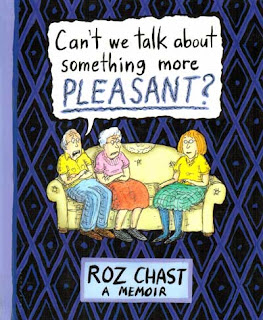

The cover of the album

Wednesday, 22 July 2015

Analysis of ten grassroots comics made by female participants with disabilties in workshops in Mwanza, Tanzania

The cover of the book with a grassroot comic on secondary education for the deaf.

In 2010 Sanna Hukkanen and Sunday Ngakama conducted four grassroots comics workshops in Mwanza in collaboration with some Tanzanian NGOs that work with people with disabilities. The workshop was organised by SHIVYAWATA (an umbrella organisation) and funded by Abilis Foundation from Finland.

Adjunct professor Elina Lehtomäki of the University of Helsinki is an activist for education rights of persons with disabilities. She has written together with Sanna Hukkanen, a longtime member of World Comics Finland and an accomplished comics trainer, an article called “Tanzanian Girls and Women with (Dis)abilities Claim Their Right to Education" in the book "Inclusive Education Twenty Years After Salamanca" (Salamanca, Spain was the venue for a landmark conference on special needs education in 1994). The book was published by Peter Lang Publishing, Inc. of New York, U.S in a series called Disability Studies in Education.

Ten grassroots comics and their messages are analyzed thoroughly in the article, which concludes that the comics provide critical insights of what the girls and their families see as important in their education and learning in Tanzania.

The authors make it clear that grassroots comics can contribute with empowering tools to uncover abilities and voices, and they could therefore be used on the ground to help finding out the views and experiences of girls and women with (dis)abilities.


Posted by Leif Packalen